

Apple Watch Series 12 during an outdoor workout. Image: Apple.
The short answer
Series 12 makes the strongest case for older-Watch owners
Apple Watch Series 12 is worth considering for Series 8-or-older owners, anyone dealing with a tired battery, and people who will use its new Health Sensing System and Readiness score. Series 10 and Series 11 owners can usually wait. The exterior remains familiar, normal-use battery is still rated at 24 hours, and several watchOS 27 improvements also reach supported earlier Watches.
Review basis: Techpod has not independently worn or lab-tested Series 12. This buying review combines Apple's published specifications with launch-week reporting from WIRED, Tom's Guide, 9to5Mac and TechRadar.
Apple Watch Series 12 at a glance
Apple's U.S. starting price at launch.
General availability began in launch markets.
Aluminum and titanium; ceramic cases measure 43mm or 47mm.
A dual-core processor with a 4-core Neural Engine.
Normal use, or up to 38 hours in Low Power Mode.
Apple's stated fast-charge result under its test conditions.
Price, availability, battery and charging figures come from Apple's launch announcement and technical specifications. Battery and charging results vary with configuration, use, cellular connection, starting charge, adapter and environment.
What launch-week reviewers agree on
The clearest Series 12 changes sit under the glass. WIRED, Tom's Guide, 9to5Mac and TechRadar all emphasized the health-sensing hardware and day-to-day charging convenience over a dramatic visual redesign. That agreement makes the buying decision relatively simple: Series 12 earns its place when those internal changes matter to your routine.
The familiar shape is an advantage for buyers who already like Apple Watch. Bands, controls and the basic interaction pattern need little relearning. It also limits the emotional pull for recent-model owners. A Series 11 still looks current, carries the same 24-hour normal-use rating, and receives many improvements through watchOS 27.
Faster top-ups are easier to notice. Apple lists about 30 minutes to reach 80 percent, plus up to 12 hours of normal use from 15 minutes of charging. Reviewers at WIRED, Tom's Guide and 9to5Mac each treated that quicker recovery as a practical improvement. It helps during a shower or breakfast break, although it does not turn Series 12 into a multi-day Watch.
The Health Sensing System is the strongest reason to upgrade
Series 12 combines a second-generation electrical heart sensor, an always-on optical heart sensor, blood oxygen sensing where available, and a temperature sensor. Apple says the system can check heart rate every five seconds through the day and measure heart-rate variability more frequently than previous Apple Watches. Those higher-frequency signals feed the new Readiness app.
Readiness gives a score from 0 to 10 using recent activity, training load, overnight vitals and sleep. The value lies in the pattern rather than a single morning number. A consistently low score may encourage a lighter workout; a rebound can show that the same routine is becoming easier to absorb.
Apple bases its accuracy claims on company-run comparisons, including a study of more than 1,000 participants. The feature is a wellness tool. It does not diagnose a condition, and one week of reviews cannot establish its long-term value. Buyers who already review sleep, training load and recovery data have the clearest use case. People who mainly use notifications, timers and casual activity rings may see less benefit.

Battery life stays familiar; charging gets easier
Apple rates Series 12 for up to 24 hours of normal use, up to 38 hours in Low Power Mode and up to 10 hours of outdoor workout use. The first two numbers match Series 11. Travelers and endurance athletes who want a larger reserve should compare the Ultra line as well.
The charging curve is the more useful change for everyday buyers. Series 12 is rated to reach up to 80 percent in about 30 minutes. Apple also says five minutes can provide up to 10 hours of sleep tracking. These figures give the Watch more chances to recover during short gaps, which matters when daytime wear and overnight sleep tracking compete for the same battery.
Real battery life will vary. Display use, workouts, cellular time, Wi-Fi, audio playback, notifications, temperature and battery age all affect the result. Buyers replacing a much older Watch may experience a bigger improvement simply because the new battery starts at full health.
A familiar design with new materials
The aluminum and titanium versions remain 42mm and 46mm, while the new ceramic versions measure 43mm and 47mm. Series 12 adds dark bronze, light gold, black and space gray aluminum; radiant gold and natural titanium; and pearl white or night blue ceramic. The ceramic choices bring a more jewelry-like finish back to the numbered line.
Apple lists Ceramic Shield 2 for aluminum cases and sapphire crystal for titanium and ceramic. The always-on display reaches up to 2,000 nits and drops to 1 nit. 9to5Mac noted the subtle width change, while the broader week-one consensus described the overall form as closely related to Series 11.
That continuity makes the Series 12 easier to recommend as a tool than as a fashion reset. Pick it for sensing, charging or a material you specifically want. The appearance alone offers a modest reason to replace a recent Watch.
Siri AI and Audio Intelligence need an availability check
The S11 chip supports Audio Intelligence features including Shazam, Sound Recognition, Live Rewind and Siri Recap. Apple describes Live Rewind as a way to see text from the previous 15 seconds of a conversation, while Siri Recap can summarize a conversation afterward.
Timing matters. Siri AI remains a watchOS 27 beta feature with device, language and regional conditions. Apple says Live Rewind and Siri Recap will arrive in beta later in 2026 and require an Apple Intelligence-enabled iPhone 16 or later nearby, excluding iPhone 16e. Sound Recognition and other functions also vary by market and setup.
Buy the Watch for features available in your region today
Apple's support and feature-availability pages can change after launch. Confirm the exact Siri AI, language, nearby-iPhone and regional requirements before treating an intelligence feature as part of your purchase decision.
Apple Watch Series 12 vs Series 11
| Feature | Series 12 | Series 11 | What it means |
|---|---|---|---|
| Chip | S11 | S10 | Series 12 adds the hardware platform for its new sensor and intelligence features. |
| Health sensing | New Health Sensing System; high-frequency background heart rate and Recovery HRV | Previous-generation health sensor set | The main hardware-exclusive reason to upgrade. |
| Readiness | Readiness app using the new health signals | No Series 12 Health Sensing System | Most relevant to people who act on recovery and training data. |
| Normal battery | Up to 24 hours | Up to 24 hours | No rated gain for normal use. |
| Low Power Mode | Up to 38 hours | Up to 38 hours | Rated endurance remains equal. |
| Fast charge | Up to 80% in about 30 minutes; 15 minutes for up to 12 hours | Up to 80% in about 30 minutes; 15 minutes for up to 8 hours | Series 12 gets more stated normal use from a short top-up. |
| Cases | Aluminum, titanium or ceramic | Aluminum or titanium | Ceramic is the major new material choice. |
| watchOS 27 | Supported, including Series 12-specific hardware features | Supported; many software features overlap | Separate software upgrades from new hardware before buying. |
Comparison data: Apple Watch model comparison, checked September 22, 2026. Apple lists an outdoor-workout figure for Series 12 without an equivalent Series 11 figure in the current comparison, so that row is omitted.
Who should buy, consider or keep what they have?
Upgrade
You use a Series 8 or older Watch, your current battery no longer covers the day, or you will regularly use Readiness and the new health signals.
Consider
You own Series 9 or Series 10 and want faster top-ups, a ceramic finish, or a specific Series 12 health feature that changes your routine.
Keep what you have
Your Series 11 battery is healthy, its current features cover your day, and the Series 12 sensing or intelligence additions do not solve a clear need.
The purchase case becomes stronger when several needs overlap. A Series 7 owner with reduced battery capacity, an interest in overnight tracking and a desire for faster charging sees more change than a Series 11 owner who charges at the same time every evening.
Give the Watch you replace a next job
An upgrade leaves one practical question: what happens to the previous Watch? Decide while it is still charged, paired and easy to identify. It can become a backup, stay in rotation with the same iPhone, go to another person where Apple's setup requirements permit, be sold or traded, or take a narrower second-life role.
For a broader decision tree, see five smart options for an old Apple Watch. Owners who want to keep two Watches can also read how two Apple Watches can share one iPhone after an upgrade.
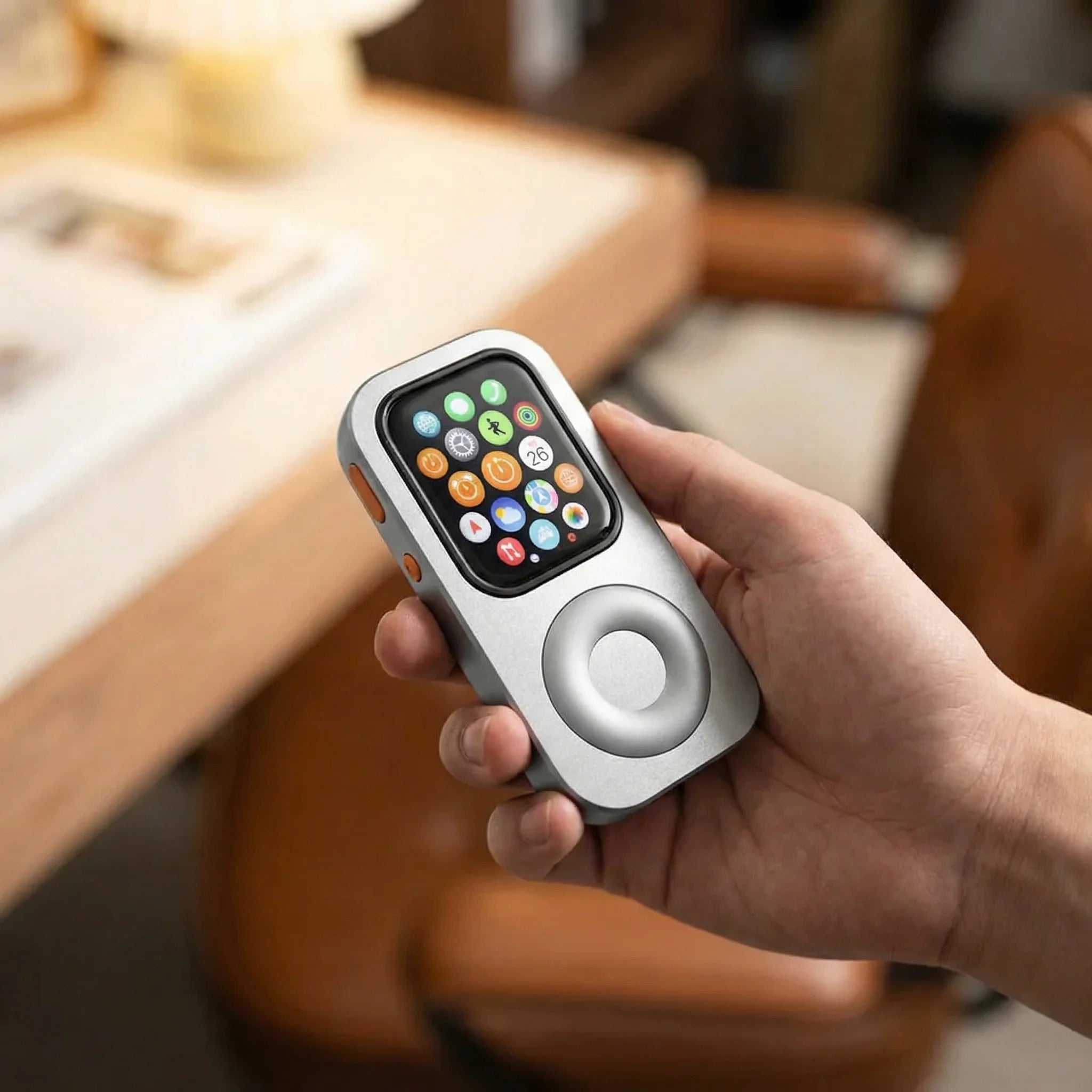
RePod gives a listed compatible Apple Watch an iPod-inspired handheld form. The Watch continues to provide the screen, watchOS, apps and available services. Fit depends on the exact generation and case size. Series 12 is absent from the currently known RePod compatibility selector, so the relevant device to check after upgrading is the previous Watch. Confirm the live selector before ordering.
For the Watch you replace
Check your previous Watch fit
Match its exact generation and case size to a currently listed RePod variant.
Apple Watch Series 12 FAQ
Is Apple Watch Series 12 worth upgrading to?
Series 12 is most compelling for owners of a Series 8 or older Watch, people with a worn battery, and buyers who will use the new Health Sensing System and Readiness score. Series 10 and Series 11 owners should compare one specific need before upgrading because the design is familiar and normal-use battery remains rated at 24 hours.
Should Series 11 owners upgrade to Series 12?
Most Series 11 owners can wait. Series 12 adds the S11 chip, the new Health Sensing System, Readiness, faster charging and new material choices, while both models carry Apple's 24-hour normal-use and 38-hour Low Power Mode ratings. Upgrade when one of the new health or charging features solves a real daily problem.
How long does Apple Watch Series 12 battery last?
Apple rates Series 12 for up to 24 hours of normal use, up to 38 hours in Low Power Mode and up to 10 hours of outdoor workout use. Apple also says a 15-minute charge can provide up to 12 hours of normal use. Actual results vary with settings, network conditions and use.
Does Apple Watch Series 12 have Siri AI?
Series 12 supports Siri AI through watchOS 27, subject to supported devices, languages and regions. Apple says Live Rewind and Siri Recap will arrive in beta later in 2026 and require a compatible Apple Intelligence-enabled iPhone nearby. Check Apple's current feature-availability pages before buying for these functions.
Does Apple Watch Series 12 fit RePod?
Series 12 is absent from the currently known RePod compatibility selector. RePod fit depends on the exact Apple Watch generation and case size. Check the live selector before ordering, and consider RePod only for a previous Watch that is explicitly listed as compatible.
Sources and further reading
- Apple Newsroom — Introducing Apple Watch Series 12 (September 9, 2026)
- Apple — Apple Watch Series 12 technical specifications (checked September 22, 2026)
- Apple — Series 12 and Series 11 comparison (checked September 22, 2026)
- WIRED — Apple Watch Series 12 review (September 17, 2026)
- Tom's Guide — Apple Watch Series 12 review (September 17, 2026)
- 9to5Mac — Apple Watch Series 12 and Ultra 4 review (September 17, 2026)
- TechRadar — One week with Apple Watch Series 12 (September 17, 2026)
- Techpod — Apple Watch Series 12 price, features and history